






# The Art of Precision: Creating Miniature Gears on Swiss CNC Machines
In the world of precision manufacturing, few things showcase the capabilities of modern CNC technology quite like the production of miniature gears. Swiss-type CNC machines, in particular, have revolutionized how we approach micro-machining, enabling manufacturers to create components with tolerances that were once thought impossible.
## What Makes Swiss Machining Special?
Swiss-type CNC machines, originally developed in Switzerland for the watchmaking industry, excel at producing small, precise parts. Unlike conventional lathes, Swiss machines feature a sliding headstock that moves the workpiece through a guide bushing. This unique design provides exceptional support close to the cutting point, minimizing deflection and vibration – crucial factors when machining tiny components like miniature gears.
## The Challenge of Tiny Gear Manufacturing
Creating miniature gears presents several unique challenges:
### 1. **Extreme Precision Requirements**
Gear teeth must be perfectly formed and evenly spaced. Even microscopic variations can cause gear failure or excessive wear. When working with gears that may be only a few millimeters in diameter, maintaining tolerances of ±0.0001″ becomes critical.
### 2. **Material Considerations**
Tiny gears often require specialized materials that can withstand high stress concentrations. Common choices include:
– Hardened steel alloys
– Brass for lower-stress applications
– Titanium for aerospace components
– Engineering plastics for specific industries
### 3. **Tool Selection and Wear**
Machining miniature features requires micro-tools that can be as small as 0.1mm in diameter. These tools are extremely fragile and prone to rapid wear, requiring constant monitoring and frequent replacement.
## The Swiss Machining Process for Tiny Gears
### Step 1: Design and Programming
Modern CAD/CAM software allows engineers to design gears with precise tooth profiles. The software generates toolpaths that account for the specific geometry of each tooth, ensuring optimal cutting conditions.
### Step 2: Setup and Alignment
Proper setup is crucial. The guide bushing must be perfectly aligned, and the workpiece must be centered with extreme accuracy. Even a few microns of misalignment can result in defective parts.
### Step 3: Roughing Operations
Initial material removal creates the basic gear blank. Swiss machines excel here, as the sliding headstock maintains constant support throughout the cut.
### Step 4: Gear Tooth Formation
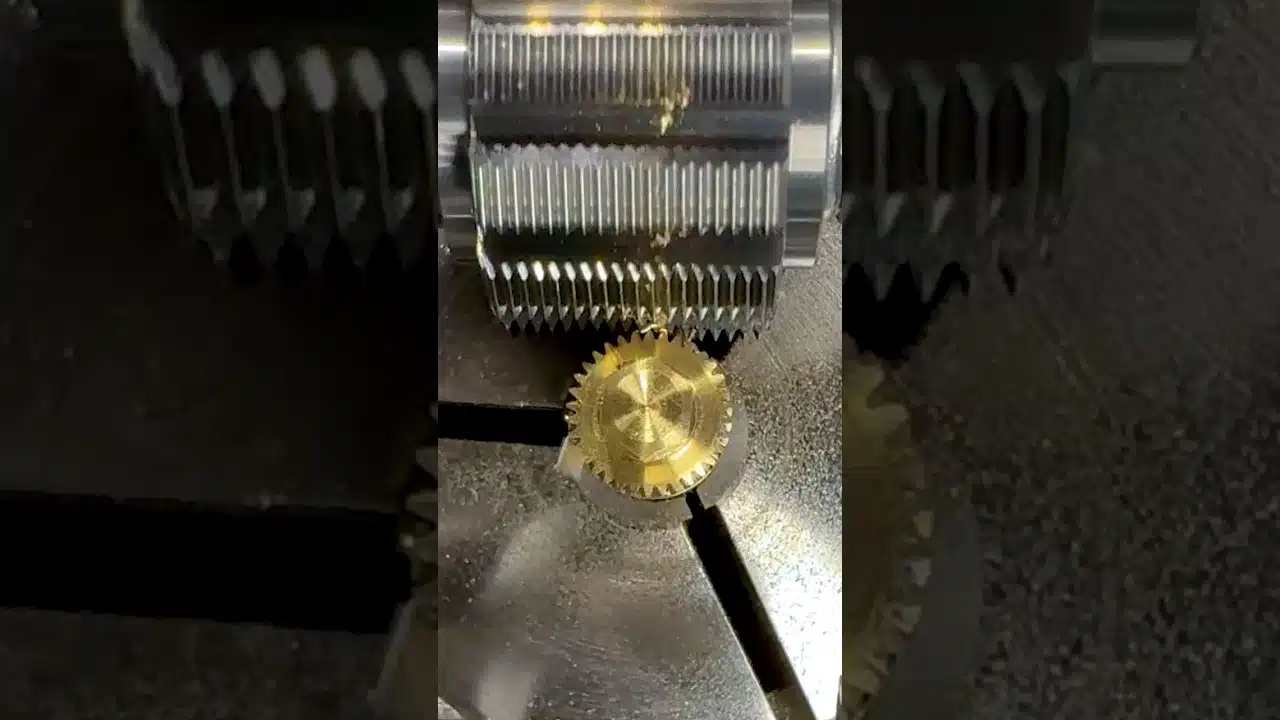
This is where the magic happens. Using specialized gear cutting tools or through synchronized milling operations, each tooth is carefully formed. The process requires:
– Precise spindle synchronization
– Optimal cutting speeds and feeds
– Continuous coolant flow to manage heat and chip evacuation
### Step 5: Finishing Operations
Final passes ensure surface finish requirements are met. This might include:
– Deburring operations
– Surface treatments
– Quality inspection using optical or tactile measurement systems
## Applications for Miniature Gears
Tiny gears manufactured on Swiss machines find their way into numerous industries:
– **Medical Devices**: Surgical instruments, implantable devices, and diagnostic equipment
– **Aerospace**: Actuators, control systems, and instrumentation
– **Electronics**: Precision motors, camera mechanisms, and robotics
– **Automotive**: Fuel injection systems, sensors, and micro-actuators
– **Watchmaking**: The original application, still requiring the highest precision
## Quality Control in Micro-Gear Manufacturing
Inspecting miniature gears requires specialized equipment:
– Optical comparators for profile verification
– Coordinate measuring machines (CMMs) with micro-probes
– Gear inspection systems that can measure pitch, runout, and tooth profile
– Surface finish analyzers for critical applications
## The Future of Miniature Gear Manufacturing
As technology continues to advance, we’re seeing:
– Integration of AI for predictive tool wear monitoring
– Advanced materials enabling even smaller, stronger gears
– Hybrid manufacturing processes combining additive and subtractive methods
– Increased automation for lights-out manufacturing
## Conclusion
The ability to manufacture tiny gears on Swiss CNC machines represents the pinnacle of precision machining. It combines advanced technology, skilled craftsmanship, and meticulous attention to detail. As industries continue to demand smaller, more precise components, Swiss machining will remain at the forefront of manufacturing innovation.
Whether you’re in the medical, aerospace, or electronics industry, understanding the capabilities and limitations of Swiss machining for miniature gear production can open new possibilities for product design and functionality. The next time you use a device with smooth, precise motion, remember the incredible technology and skill required to create those tiny gears spinning inside.
What Should I Do Right Now?
If you’re evaluating new machining processes or equipment, our team can help you determine the best approach for your specific parts, offering guidance, insights, and practical recommendations based on your production needs and goals. Whether you’re optimizing existing workflows or exploring new manufacturing methods, we’re here to support your decision-making.
You Might Also Like
Fixing Titanium Forgings with CNC Machining: Challenges, Techniques & Expert Tips
# Fixing Titanium Forgings: The Art and Science of CNC Machining Titanium forgings are among the most challenging workpieces in the world of CNC machining.…
EATER of Titanium: Watch This CNC Machine Devour Titanium Like Butter
# EATER of Titanium: The CNC Machine That Devours the Toughest Metal There’s something deeply satisfying about watching a CNC machine tear through titanium like…
Crazy Titanium CNC Machining Part – Day 1 | Donnie Hinske’s Epic Build
# Crazy Titanium Part | Day 1: The CNC Machining Journey Begins There’s something deeply satisfying about watching raw titanium transform into a precision-engineered component…