






# Would You Try This on a 40 Taper Machine?
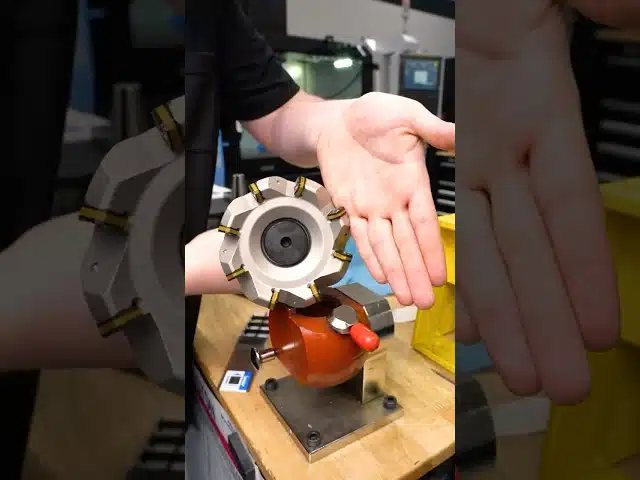
In the world of CNC machining, there’s a fine line between pushing the limits of your equipment and pushing your luck. A recent video from machinist and content creator **Donnie Hinske** has sparked a lively debate in the machining community, posing a simple but loaded question: *Would you try this on a 40 taper machine?*
## Understanding the 40 Taper: Capabilities and Limitations
For those who may not be deeply familiar with CNC machine specifications, the “taper” refers to the spindle taper size — essentially the interface between the machine’s spindle and the toolholder. A **40 taper** (commonly referred to as CAT40 or BT40) is one of the most popular spindle sizes in the industry. It’s the workhorse of many job shops and production facilities worldwide.
But here’s the thing: while 40 taper machines are incredibly versatile, they do have their limits. Compared to their bigger siblings — the 50 taper machines — they offer less rigidity, less torque at lower RPMs, and less overall mass to absorb the forces generated during heavy cutting operations. This is precisely what makes the question in Donnie’s video so compelling.
## The Risk Factor in CNC Machining
Every machinist knows that risk management is a daily part of the job. Whether it’s choosing the right feeds and speeds, selecting appropriate tooling, or deciding whether a particular operation is within the capability envelope of your machine, calculated risk is baked into the craft.
The hashtags accompanying this video — **#risk** and **#machining** — tell you everything you need to know about the nature of the content. There are operations that might be perfectly routine on a 50 taper machine that become genuinely risky propositions on a 40 taper setup. We’re talking about:
– **Heavy hogging operations** with large face mills or shell mills
– **Deep slotting cuts** that generate significant radial forces
– **Large-diameter boring operations** where tool deflection becomes critical
– **Aggressive roughing passes** in tough materials like stainless steel, Inconel, or titanium
## When Machinists Push the Envelope
What makes content like Donnie Hinske’s so valuable to the machining community is that it opens up real-world discussions about what’s actually possible versus what the textbook says. Many experienced machinists have stories about successfully pulling off operations on machines that “shouldn’t” have been able to handle them — and just as many have cautionary tales about what happens when things go wrong.
Pushing a 40 taper machine beyond its typical comfort zone can lead to several issues:
1. **Spindle damage** — Excessive forces can wear out spindle bearings prematurely or, in extreme cases, cause catastrophic spindle failure.
2. **Poor surface finish** — Chatter and vibration from insufficient rigidity will show up immediately in your part quality.
3. **Tool breakage** — When the machine can’t maintain stability, tools bear the brunt of the consequences.
4. **Dimensional inaccuracy** — Deflection in the spindle, toolholder, and tool assembly can throw your tolerances out the window.
5. **Workholding failure** — If the cutting forces exceed what your vise or fixture can handle, you’ve got a projectile on your hands.
## The Community Weighs In
Videos like this tend to generate passionate responses from machinists across the spectrum. You’ll find the bold operators who say, “I do this every day on my 40 taper — no problem.” And you’ll find the cautious veterans who shake their heads and say, “Just because you can doesn’t mean you should.”
Both perspectives have merit. A well-maintained, high-quality 40 taper machine with premium toolholders and proper programming can accomplish more than many people give it credit for. At the same time, understanding the mechanical limitations of your equipment isn’t being timid — it’s being smart.
## Tips for Pushing Your 40 Taper Machine Safely
If you find yourself needing to tackle aggressive operations on a 40 taper machine, here are some strategies to mitigate risk:
– **Use high-quality toolholders** — Shrink-fit or hydraulic holders provide better rigidity and runout compared to standard collet chucks.
– **Optimize your toolpaths** — High-efficiency milling (HEM) strategies like trochoidal milling can reduce radial engagement while maintaining high metal removal rates.
– **Monitor your spindle load** — Keep a close eye on your machine’s spindle load meter and back off if you’re consistently running at high percentages.
– **Reduce tool stick-out** — Minimize the distance between the spindle face and the cutting edge whenever possible.
– **Choose the right tooling** — Sometimes a smaller diameter tool with optimized parameters will outperform a larger tool that overwhelms the machine.
– **Listen to your machine** — Experienced machinists can hear when a machine is struggling. If it sounds wrong, it probably is.
## The Bottom Line
Donnie Hinske’s video serves as a great conversation starter for one of machining’s most practical debates: knowing where the line is between ambitious and reckless. A 40 taper machine is an incredibly capable piece of equipment, but every machine has its limits.
The best machinists aren’t necessarily the ones who take the biggest risks — they’re the ones who understand their equipment intimately, respect its boundaries, and find creative ways to maximize productivity within those constraints.
So, would *you* try it on a 40 taper machine? The answer, as with most things in machining, is: **it depends.** And that’s exactly the kind of nuanced discussion that makes the CNC machining community so great.
—
*What’s your experience with pushing 40 taper machines to their limits? Have you ever attempted an operation that made you question whether your machine was up to the task? Share your stories and tips in the comments below!*
What Should I Do Right Now?
If you’re evaluating new machining processes or equipment, our team can help you determine the best approach for your specific parts, offering guidance, insights, and practical recommendations based on your production needs and goals. Whether you’re optimizing existing workflows or exploring new manufacturing methods, we’re here to support your decision-making.
You Might Also Like
Fixing Titanium Forgings with CNC Machining: Challenges, Techniques & Expert Tips
# Fixing Titanium Forgings: The Art and Science of CNC Machining Titanium forgings are among the most challenging workpieces in the world of CNC machining.…
EATER of Titanium: Watch This CNC Machine Devour Titanium Like Butter
# EATER of Titanium: The CNC Machine That Devours the Toughest Metal There’s something deeply satisfying about watching a CNC machine tear through titanium like…
Crazy Titanium CNC Machining Part – Day 1 | Donnie Hinske’s Epic Build
# Crazy Titanium Part | Day 1: The CNC Machining Journey Begins There’s something deeply satisfying about watching raw titanium transform into a precision-engineered component…