






# It’s CRAZY How Much THIS Deflects: Understanding Tool Deflection in CNC Machining
If you’ve spent any time around CNC machines, you know that precision is everything. But there’s a sneaky little problem that can sabotage even the most carefully planned machining operations: **tool deflection**. And as Donnie Hinske demonstrates in his latest video, the amount of deflection that can occur might genuinely shock you.
## What Is Tool Deflection?
Tool deflection occurs when cutting forces push the tool (or workpiece) away from its intended path during machining. Think of it like trying to carve something with a long, thin stick — the further the stick extends, the more it bends under pressure. The same principle applies to end mills, boring bars, and other cutting tools in CNC machining.
Even though we’re dealing with hardened steel and carbide tooling, deflection is a very real phenomenon that affects dimensional accuracy, surface finish, and even tool life.
## Why Does Deflection Matter So Much?
The consequences of ignoring tool deflection can be significant:
– **Dimensional inaccuracy**: Your finished part may not match the programmed dimensions, leading to out-of-tolerance parts and costly scrap.
– **Poor surface finish**: A deflecting tool chatters and vibrates, leaving behind a rough, inconsistent surface.
– **Premature tool wear**: Uneven cutting forces caused by deflection accelerate tool wear and can lead to unexpected tool breakage.
– **Inconsistent results**: Deflection can vary based on cutting conditions, making it difficult to achieve repeatable results across a production run.
## Common Causes of Tool Deflection
Several factors contribute to how much a tool deflects during a cut:
### 1. Tool Stick-Out Length
This is one of the biggest culprits. The longer the tool extends from the holder, the more leverage cutting forces have to bend it. Deflection increases exponentially with length — doubling the stick-out can increase deflection by a factor of eight.
### 2. Tool Diameter
Smaller diameter tools are inherently less rigid. A 1/4″ end mill will deflect far more than a 1/2″ end mill under the same conditions.
### 3. Cutting Forces
Aggressive depths of cut, high feed rates, and hard materials all increase the forces acting on the tool, which in turn increases deflection.
### 4. Tool Material and Construction
Carbide tools are stiffer than HSS (high-speed steel) tools. Solid carbide end mills deflect less than indexable tools in some configurations.
### 5. Tool Holder Quality
A worn or low-quality tool holder can introduce additional runout and flex, compounding the deflection problem.
## How to Minimize Tool Deflection
Now that we understand the problem, here are some practical strategies to keep deflection in check:
– **Minimize stick-out**: Only extend the tool as far as absolutely necessary for the operation.
– **Use the largest diameter tool possible**: A bigger tool means more rigidity.
– **Reduce cutting forces**: Take lighter cuts with appropriate feeds and speeds. Sometimes multiple lighter passes beat one aggressive pass.
– **Choose carbide over HSS**: When rigidity is critical, solid carbide tools offer a significant advantage.
– **Use high-quality tool holders**: Shrink-fit and hydraulic holders provide better concentricity and grip than standard collet chucks.
– **Consider climb milling**: Climb milling generally produces more consistent cutting forces compared to conventional milling, which can help manage deflection.
– **Apply roughing and finishing strategies**: Rough with conservative parameters and leave a small amount of stock for a light finishing pass where deflection is minimal.
## The Visual Proof
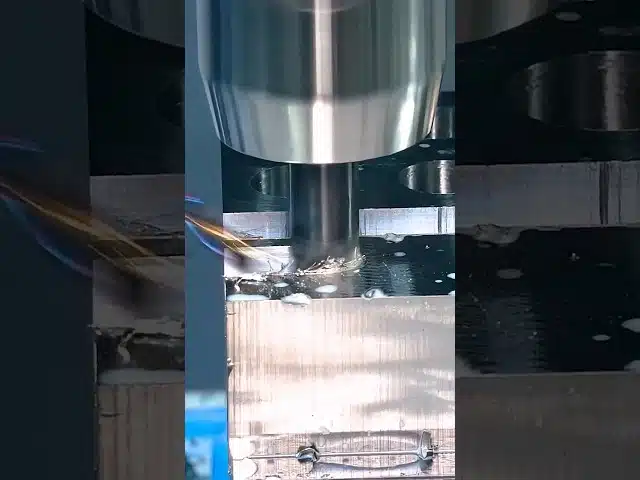
What makes Donnie Hinske’s video so compelling is the visual demonstration of just how much deflection actually occurs. It’s one thing to read about it in a textbook — it’s another thing entirely to *see* a tool bending under cutting forces in real time. These kinds of real-world demonstrations are invaluable for machinists at every level, from beginners to seasoned pros.
It serves as a powerful reminder that CNC machining isn’t just about programming the right G-code. Understanding the physics of what’s happening at the cutting edge is essential for producing accurate, high-quality parts.
## Final Thoughts
Tool deflection is one of those topics that separates good machinists from great ones. It’s easy to overlook, especially when everything *looks* fine on the screen. But the difference between a part that’s in tolerance and one that’s not often comes down to managing the invisible forces at play during the cut.
Next time you’re setting up a job, take a moment to consider your tool stick-out, your cutting parameters, and your tooling choices. A little awareness of deflection can go a long way toward better parts, longer tool life, and fewer headaches on the shop floor.
Be sure to check out [Donnie Hinske’s YouTube channel](https://www.youtube.com/@DonnieHinske) for more insightful CNC machining content that bridges the gap between theory and practice.
What Should I Do Right Now?
If you’re evaluating new machining processes or equipment, our team can help you determine the best approach for your specific parts, offering guidance, insights, and practical recommendations based on your production needs and goals. Whether you’re optimizing existing workflows or exploring new manufacturing methods, we’re here to support your decision-making.
You Might Also Like
Fixing Titanium Forgings with CNC Machining: Challenges, Techniques & Expert Tips
# Fixing Titanium Forgings: The Art and Science of CNC Machining Titanium forgings are among the most challenging workpieces in the world of CNC machining.…
EATER of Titanium: Watch This CNC Machine Devour Titanium Like Butter
# EATER of Titanium: The CNC Machine That Devours the Toughest Metal There’s something deeply satisfying about watching a CNC machine tear through titanium like…
Crazy Titanium CNC Machining Part – Day 1 | Donnie Hinske’s Epic Build
# Crazy Titanium Part | Day 1: The CNC Machining Journey Begins There’s something deeply satisfying about watching raw titanium transform into a precision-engineered component…