






# Tools Work Better on Center: A CNC Machining Fundamental You Need to Know
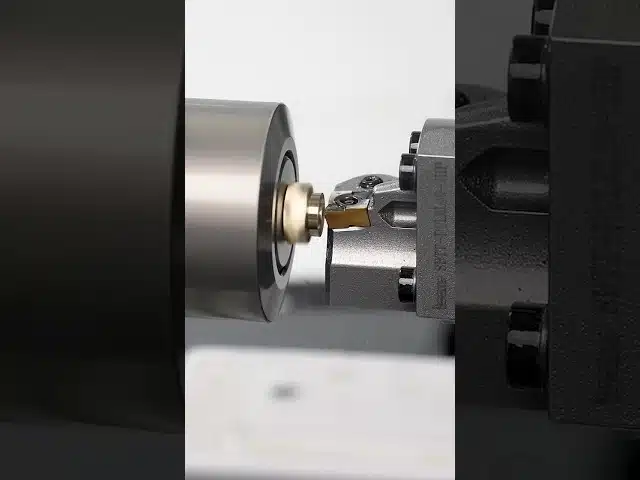
If you’ve spent any time around CNC machines or manual lathes, you’ve probably heard the phrase “make sure your tool is on center.” But have you ever truly seen the difference it makes? A recent short video from machinist Donnie Hinske demonstrates this concept perfectly — and the results might just blow your mind. 🤯
## What Does “On Center” Mean in Machining?
When machinists talk about a tool being “on center,” they’re referring to the cutting tool’s edge being aligned precisely with the centerline of the workpiece — the axis around which the part rotates. This is especially critical in lathe operations, where the relationship between the tool tip and the spindle centerline directly affects cutting performance, surface finish, and tool life.
On a lathe, the centerline is the imaginary horizontal line that runs through the exact center of the spinning workpiece. When your cutting tool is positioned exactly at this height, it engages the material at the optimal angle, allowing it to shear the metal cleanly and efficiently.
## What Happens When Your Tool Is Off Center?
When a tool is positioned above or below center, several problems can occur:
### Tool Above Center
– The effective rake angle changes, often becoming more negative
– The tool tends to rub rather than cut cleanly
– There’s an increased risk of the tool climbing over the workpiece
– Surface finish quality degrades noticeably
– The tool can push the workpiece away rather than cutting into it
### Tool Below Center
– The tool can dig into the material unpredictably
– There’s a higher risk of catching and pulling the tool into the work
– Chatter and vibration increase significantly
– Dimensional accuracy suffers as the tool deflects
– On facing operations, you may end up with a “nub” or pip left in the center of the workpiece
## Why Does Being on Center Matter So Much?
The geometry of the cut changes dramatically with even small deviations from center. Here’s why this matters:
### 1. **Optimal Cutting Geometry**
Tool manufacturers design their inserts and cutting tools with specific rake angles and clearance angles in mind. These angles are calculated assuming the tool will be positioned on center. When you move the tool off center, you effectively alter these carefully engineered angles, reducing the tool’s ability to perform as designed.
### 2. **Better Surface Finish**
A tool on center produces a cleaner shearing action on the material. This translates directly to a better surface finish on your parts — something that can mean the difference between a part that passes inspection and one that doesn’t.
### 3. **Extended Tool Life**
When the tool is cutting at its designed geometry, it wears more evenly and predictably. Off-center tools experience uneven wear patterns, increased heat generation, and premature failure. Over time, keeping your tools on center can save you significant money in tooling costs.
### 4. **Improved Dimensional Accuracy**
Clean, consistent cuts mean more predictable results. When you’re working to tight tolerances, having your tool on center is non-negotiable.
## How to Set Your Tool on Center
For those newer to machining, here are some tried-and-true methods for getting your tool on center:
– **Use a ruler or scale against the chuck face:** Hold a metal ruler vertically against the face of the chuck. Adjust the tool height until the tip just touches the ruler at the center point.
– **Test cut method:** Make a facing cut toward the center. If there’s a small nub left, your tool is slightly above or below center. Adjust accordingly.
– **Height gauges and tool presetters:** For CNC work, precision tool presetters can measure exact tool heights for repeatable setups.
– **Dial indicators:** Use a dial indicator to measure from a known reference surface to the tool tip.
## A Simple Tip That Makes a Big Difference
As Donnie Hinske’s video clearly shows, this isn’t just textbook theory — it’s a practical reality that affects every cut you make. Whether you’re a seasoned CNC machinist or just getting started in the trade, taking the extra minute to verify your tool is on center pays dividends in part quality, tool life, and overall machining efficiency.
It’s one of those fundamentals that separates good machinists from great ones. The next time you set up a job, take that extra moment to check — your tools, your parts, and your bottom line will thank you.
## Final Thoughts
Machining is a craft built on precision, and the details matter. Something as seemingly minor as tool height alignment can have a massive impact on your results. Videos like this one serve as excellent reminders that mastering the basics is the foundation of machining excellence.
Have you experienced the difference that on-center tooling makes in your shop? It’s one of those “did you know” moments that, once you see it, you never forget.
What Should I Do Right Now?
If you’re evaluating new machining processes or equipment, our team can help you determine the best approach for your specific parts, offering guidance, insights, and practical recommendations based on your production needs and goals. Whether you’re optimizing existing workflows or exploring new manufacturing methods, we’re here to support your decision-making.
You Might Also Like
Fixing Titanium Forgings with CNC Machining: Challenges, Techniques & Expert Tips
# Fixing Titanium Forgings: The Art and Science of CNC Machining Titanium forgings are among the most challenging workpieces in the world of CNC machining.…
EATER of Titanium: Watch This CNC Machine Devour Titanium Like Butter
# EATER of Titanium: The CNC Machine That Devours the Toughest Metal There’s something deeply satisfying about watching a CNC machine tear through titanium like…
Crazy Titanium CNC Machining Part – Day 1 | Donnie Hinske’s Epic Build
# Crazy Titanium Part | Day 1: The CNC Machining Journey Begins There’s something deeply satisfying about watching raw titanium transform into a precision-engineered component…