






# The TINIEST INSERT I’ve Ever Seen
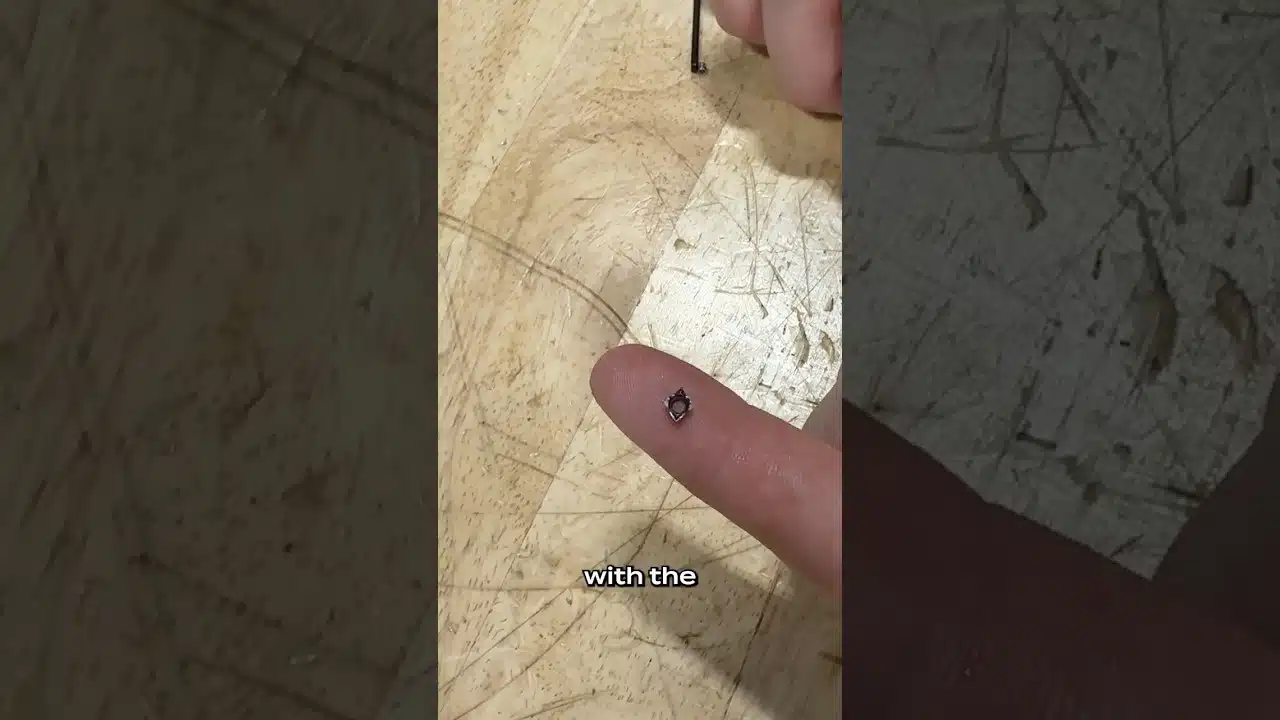
If you’ve spent any time in the world of CNC machining, you know that tooling comes in all shapes and sizes. But every now and then, something comes along that truly makes you do a double-take. That’s exactly what happened when Donnie Hinske got his hands on what might be the tiniest cutting insert he’s ever encountered.
## When Small Parts Demand Even Smaller Tools
In the world of Swiss machining, precision is everything. We’re talking about manufacturing components that are often smaller than a grain of rice — parts used in medical devices, electronics, aerospace connectors, and countless other applications where tolerances are measured in microns. To machine parts that small, you need tooling that’s equally miniature.
That’s where this incredibly tiny insert comes into play.
## Just How Small Are We Talking?
When you work in Swiss-style CNC machining, you get accustomed to working with small tooling. But there’s a difference between “small” and “unbelievably tiny.” This insert falls firmly into the latter category. It’s the kind of tool that could easily get lost between your fingertips — or disappear entirely if it hits the shop floor.
For machinists who primarily work with larger turning or milling operations, seeing an insert this small can be a genuine shock. It’s a reminder of just how specialized and advanced modern CNC machining has become.
## The Marvel of Swiss Machining
Swiss-type CNC lathes were originally developed for the watchmaking industry in Switzerland — an industry that demanded extreme precision on incredibly small components. Today, Swiss machining has expanded far beyond watches, but the core principle remains the same: **ultra-precise machining of small, complex parts.**
To achieve the level of detail and accuracy required, every element of the process needs to be dialed in — from the machine setup and programming to the cutting tools themselves. Tiny inserts like the one featured in Donnie’s video are engineered to deliver clean, precise cuts on miniature workpieces, and they represent some of the most impressive feats of tooling manufacturing in the industry.
## Why Tiny Inserts Matter
You might wonder why such a small insert is noteworthy. Here’s why:
– **Precision at Scale:** These inserts allow machinists to hold incredibly tight tolerances on parts that are already minuscule.
– **Surface Finish:** A properly designed micro-insert can produce exceptional surface finishes, reducing or eliminating the need for secondary finishing operations.
– **Material Efficiency:** In Swiss machining, bar stock is often expensive (think titanium, stainless steel, or exotic alloys). Tiny, efficient inserts help minimize material waste.
– **Tool Life:** Despite their size, modern micro-inserts are engineered with advanced coatings and geometries to maximize tool life, even on tough materials.
## A Testament to Modern Manufacturing
Seeing an insert this small is a powerful reminder of how far manufacturing technology has come. The fact that we can engineer, produce, and reliably use a cutting tool this tiny speaks volumes about the state of modern machining. From the carbide substrate to the edge preparation to the coating technology — every aspect of these micro-inserts is a marvel of engineering.
For CNC machinists, Swiss operators, and manufacturing enthusiasts alike, moments like these are what make the trade so fascinating. There’s always something new to discover, always a smaller part to make, and always a tinier tool to make it with.
## Watch the Full Video
Want to see this incredibly tiny insert for yourself? Check out Donnie Hinske’s video here: [The TINIEST INSERT I’ve Ever Seen](https://www.youtube.com/watch?v=EBvvRAzs-A0)
Whether you’re a seasoned Swiss machinist or just getting started in the world of CNC, this is one of those moments that reminds you why precision manufacturing is endlessly impressive.
—
*What’s the smallest insert or tool you’ve ever worked with? Drop a comment and let us know!*
What Should I Do Right Now?
If you’re evaluating new machining processes or equipment, our team can help you determine the best approach for your specific parts, offering guidance, insights, and practical recommendations based on your production needs and goals. Whether you’re optimizing existing workflows or exploring new manufacturing methods, we’re here to support your decision-making.
You Might Also Like
Fixing Titanium Forgings with CNC Machining: Challenges, Techniques & Expert Tips
# Fixing Titanium Forgings: The Art and Science of CNC Machining Titanium forgings are among the most challenging workpieces in the world of CNC machining.…
EATER of Titanium: Watch This CNC Machine Devour Titanium Like Butter
# EATER of Titanium: The CNC Machine That Devours the Toughest Metal There’s something deeply satisfying about watching a CNC machine tear through titanium like…
Crazy Titanium CNC Machining Part – Day 1 | Donnie Hinske’s Epic Build
# Crazy Titanium Part | Day 1: The CNC Machining Journey Begins There’s something deeply satisfying about watching raw titanium transform into a precision-engineered component…